
WhatsApp CRM for real estate in Pakistan: a guide for property teams
How property agencies in Pakistan use a WhatsApp CRM: one agency number for the team, chats linked to leads, templates after 24 hours, and what the API adds.

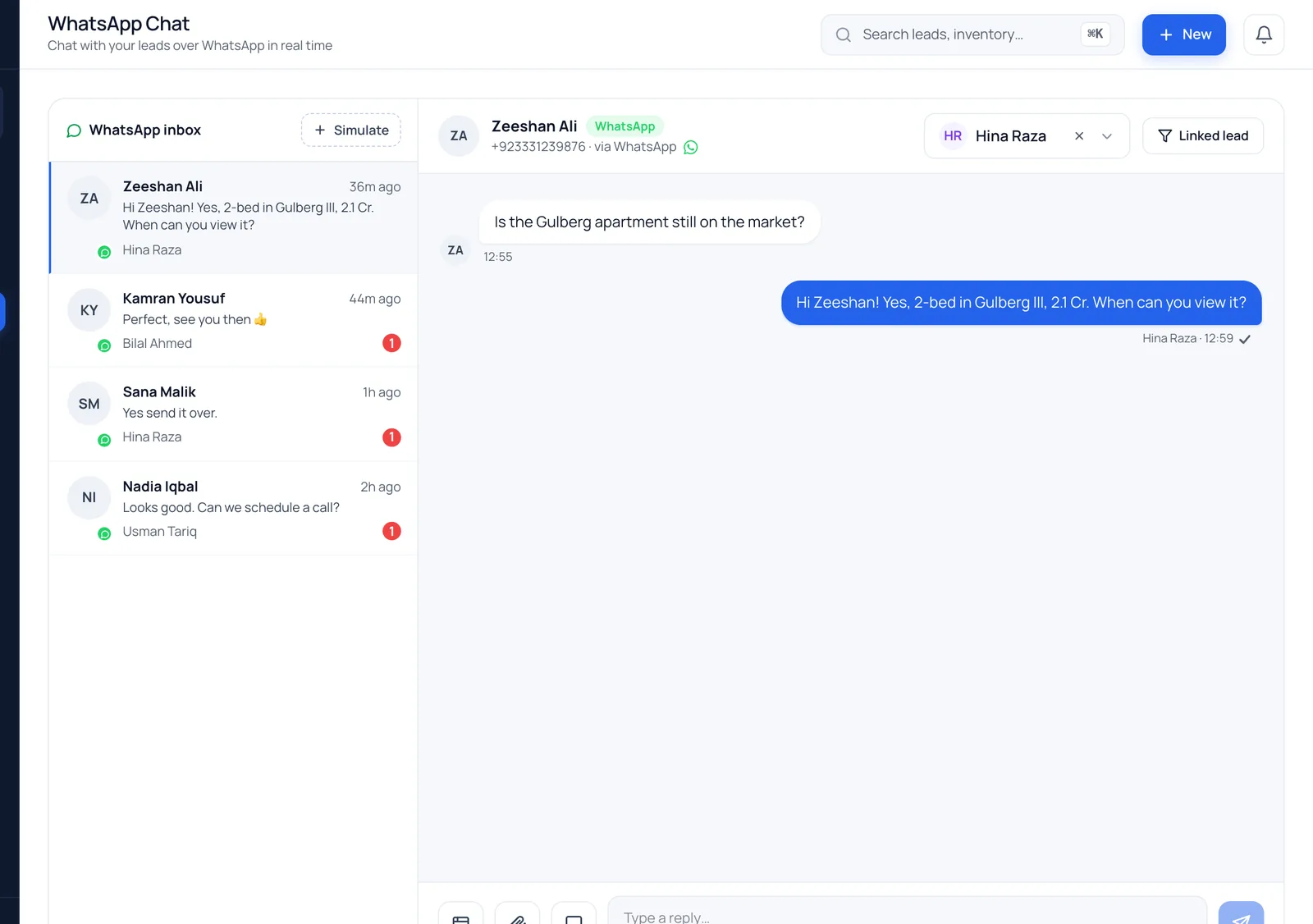
The WhatsApp Business app is fine for one person. A sales team needs one agency number, shared access, chats linked to leads and templates for follow-ups after 24 hours. That's what the WhatsApp Business Platform and a WhatsApp CRM give you.
For the general guide to the API, setup and Meta's fees, see WhatsApp Business API in Pakistan and WhatsApp Business app vs API.
The WhatsApp Business API (officially the WhatsApp Business Platform) is Meta's way for businesses to use WhatsApp through software, so a whole team can work from one number with templates, automation and a shared inbox. For property agencies in Pakistan, it is what turns WhatsApp from one person's phone into a sales system.
In Pakistan, property buyers message before they call. They message the number on your banner, reply to your Facebook ad on WhatsApp, and send voice notes asking about payment plans. For most agencies, WhatsApp is the real sales channel.
That's why it becomes a problem as the team grows. This guide explains the difference between the WhatsApp Business app and the WhatsApp Business Platform, and what a WhatsApp CRM should do for a real estate team.
Where WhatsApp breaks down for a sales team
When every agent sells from their personal WhatsApp:
- The agency can't see conversations. Nobody knows who replied to which buyer, or who left a lead on read.
- Buyers leave with the agent. When an agent moves on, their chats, and often their buyers, go with them.
- There's no link to the lead. The Facebook lead is in one place, the WhatsApp chat in another, and the follow-up in someone's memory.
- Owners hear about deals late, often after the token is paid.
Option 1: the WhatsApp Business app
The free WhatsApp Business app adds a business profile, labels, quick replies and a greeting message to a normal WhatsApp account. For a solo agent it works well.
For a team, the limits show quickly. The account is tied to one phone, with a small number of linked devices, so several agents end up sharing a phone or a login. There's no routing of new chats to agents, no record of who handled what, and no connection to your leads or reports.
Option 2: the WhatsApp Business Platform (API)
The WhatsApp Business Platform, often called the WhatsApp Business API, is Meta's official way for businesses to use WhatsApp through software. Meta hosts it (the Cloud API), and you connect a business number to it through a sign-up flow in Meta Business Manager.
What changes for an agency:
- One agency number, many agents. Chats arrive in software, not on one phone, so the whole team can reply from the same number.
- Chats become leads. A new conversation can create a lead and be assigned to an agent automatically.
- Templates. WhatsApp only allows free-form replies within 24 hours of the buyer's last message. After that, you send a pre-approved template message, such as a follow-up or a site-visit reminder.
- Automation. Instant greetings and keyword replies, for example sending the brochure when a buyer types "price".
How WhatsApp Business API pricing works
Pricing model as described by Meta in September 2026. Rates change, so always check the WhatsApp pricing page on Meta for Developers, or your rates in WhatsApp Manager.
Meta charges per message delivered, and the rate depends on the message category and the recipient's country:
- Marketing templates (offers, new project launches) cost the most.
- Utility templates (appointment and site-visit reminders, confirmations) cost less.
- Authentication templates are for one-time passwords.
- Service messages, meaning free-form replies within 24 hours of the buyer's last message, were free until 30 September 2026. From 1 October 2026 Meta charges for them too, along with utility templates sent inside an open window. Each business number gets 1,000 free service messages a month. Meta asked businesses to add a payment method to their WhatsApp Business Account by 30 September 2026; an account without one has its service messages delivered only until the 1,000 free ones are used. Full breakdown: WhatsApp Business API pricing 2026.
Chats that start from a Click-to-WhatsApp ad or a Facebook Page button still get a free window. Rates are set by Meta and change over time, so check Meta's current pricing for Pakistan before planning. With BrokLeads, your WhatsApp Business Account stays in your own Meta business portfolio and Meta bills it directly, with no markup from us. More detail: WhatsApp Business API in Pakistan.
Do you need a WhatsApp API provider in Pakistan?
Not necessarily. You can connect to Meta's Cloud API directly, through a Business Solution Provider (BSP), or through software that uses Meta's own sign-up flow. BrokLeads connects your business number through Meta's secure sign-up, so there's no separate API contract to manage and your number stays registered to your Meta Business account.
Multiple users on the same WhatsApp number
This is the main reason agencies move to the API. On the Business Platform, chats arrive in software instead of on one phone, so every agent can reply from the same agency number at the same time, each on their own login. Managers can see every conversation and transfer a chat, with its history, to another agent.
Coexistence and the verified badge
Meta now lets some businesses keep using the WhatsApp Business app on the same number after connecting it to the API (called coexistence). BrokLeads doesn't support coexistence today: a number you connect moves fully to the API, so plan which number the team will share. The verified badge is a separate thing. It used to be a green tick and is now shown as a blue check mark for verified businesses; Meta grants it on application. You don't need it to use the API or a WhatsApp CRM.
What a WhatsApp CRM adds for real estate teams
A WhatsApp CRM puts the Business Platform to work for a sales team. For a property agency, look for:
- A shared inbox on web and mobile, so agents reply from the field.
- Chats linked to leads, with the source ad or campaign, so a WhatsApp enquiry and a Facebook lead for the same buyer end up on one record.
- Assignment and transfer. New chats go to an agent automatically, and managers can move a chat, with its history, when needed.
- Templates with lead details, such as the buyer's name, filled in automatically.
- Automation rules for first messages, common keywords, after-hours enquiries and chats nobody has answered, so a midnight enquiry still gets an answer. See WhatsApp automation and our after-hours auto-reply guide.
- Media: brochures, payment plans, site photos and videos, sent and received in the chat.
- Ownership. Chats belong to the agency number, not the agent's phone.
In BrokLeads, the WhatsApp inbox is part of a wider real estate CRM: property inventory in marla, kanal or square feet, round-robin lead assignment and owner approval of every sale.
Rules that keep your number healthy
WhatsApp protects buyers from spam, and numbers that ignore the rules get restricted. A few habits keep you safe:
- Message buyers who contacted you or opted in. Don't blast purchased number lists.
- Keep marketing templates relevant: the project they asked about, not every project you sell.
- Reply to inbound questions quickly. Fast, helpful replies are also what win the site visit.
Which should you choose?
The WhatsApp Business app is a good start for one agent. Once you have a team, you need one number everyone can use, chats linked to leads, and follow-ups that keep going after 24 hours. That's the job of the WhatsApp Business Platform and a WhatsApp CRM built around it.
If your leads also come from Facebook and Instagram forms, read our guide to Facebook lead ads for real estate in Pakistan, or see how the BrokLeads WhatsApp team inbox works for a whole sales team.
Related featureWhatsApp inbox